Category Archives: Platform

Room Awareness

Paul Aubin and I were having a discussion the other night about signage.  It made me think of an age old process (age old for me at least) that I have been using since the early days of Revit and I thought I should share it.  When placing signage on a corridor wall it would be nice to have the sign be able to pick up a room id from a given distance on the other side of the wall.  As you may know that when scheduling an object it does know what space or room it is located in.  In this example the sign would know it was in the corridor and not represent the room or space it is intended for.  Families know their location in Revit by their insertion point, with hosted families the insertion point doesn’t have to be the face of the host.  I know this sounds odd but the family will host to the face, but the reference plane that defines it’s insertion may be in front of or behind the host and that is the value Revit will see to report the Room it is located in.  Yes Revit did introduce the “Room Calculation Point” tool in the family editor, but since it only goes a single direction and the distances aren’t adjustable it, in my opinion, is completely useless to me.

My solution was to add a reference plane behind the host surface (in this example the Host Back Face) and give that reference plane an instanced based parameter and set the “Is Reference” to weak and make sure the “Defines Origin” is selected.  This way I can now drag the reference plane such that it is inside the room that I need the sign to schedule.
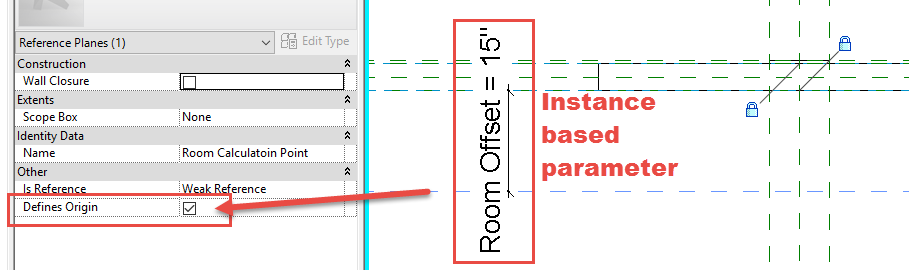
Signage Insertion Point

In the project example below I have also added a side offset such that I can place the signage in the corridor and get it to read any of the room data behind the wall.

This example has all the insertion points set to 0″ and it will read the Corridor.
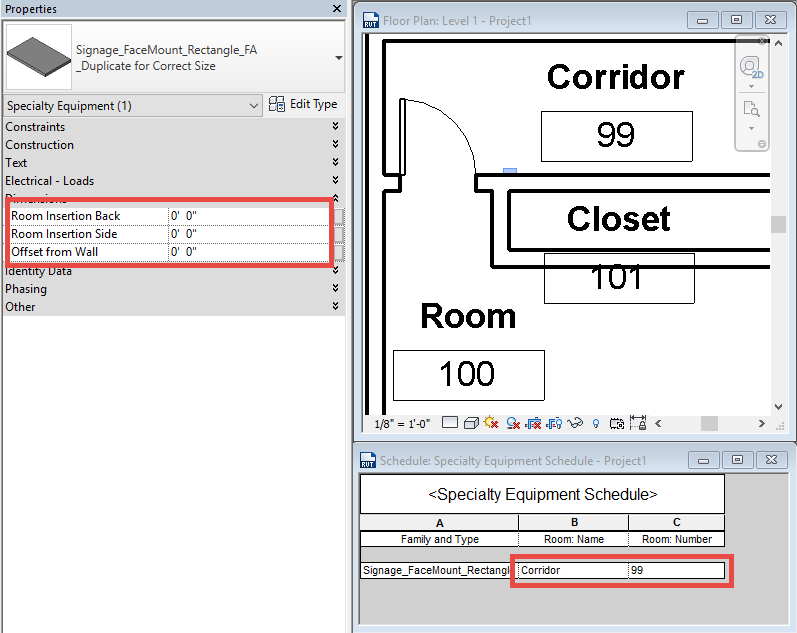
Signage Insertion 0


This example I was able to drag the insertion point (Room Insertion Back Value) to get it to register the Closet
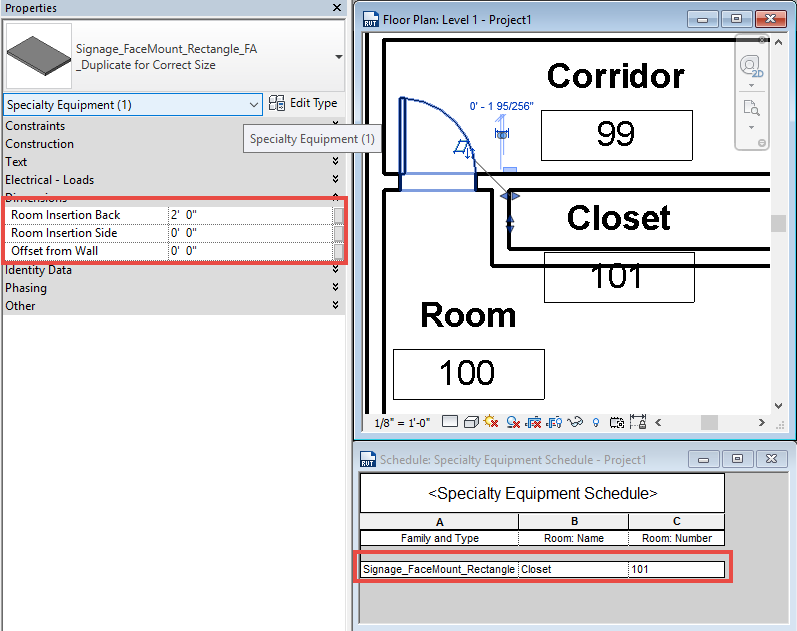
Signage Insertion Back

Then adjusting the Room Insertion Side value I can get it to schedule as Room 100
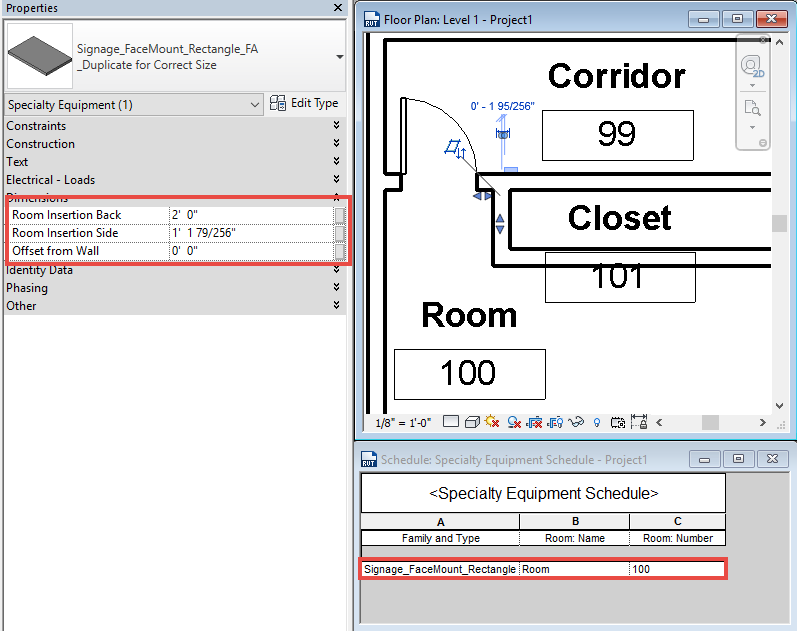
Signage Insertion Side

If you didn’t know about this trick hopefully it will inspire you to use it in other ways
Revit Family Tip

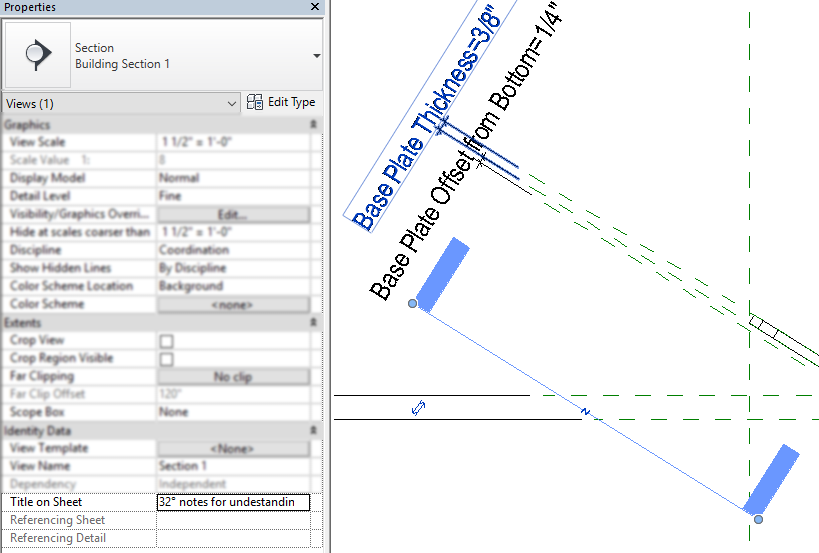
For those of you who have been following my blog you know that I can get pretty particular when creating families.  I always name my reference planes and define the “Is Reference” for example.  Occasionally I have the need to create a section in the family and sometimes I want to have notes associated to the section such that I can reference why I created it.  Yes we can change the name to give a description but what if the name becomes long or we need additional information.  One tip I have is to use the “Title on Sheet” value to help in this situation.Family Section Label

Revit 2016 R2 Structural Beams to Columns

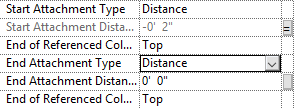
With the R2 version of 2016 Revit we were introduced to Global Parameters.  As Dezi and myself have been looking into how to utilize them she noticed a nice quirk related to them.  Previously I have posted about beams and associating them to columns and then clarified that post with a follow up.  When entering a value for the attachment distance Revit will only allow this to be a positive value, which will move the beam towards the center of the column.  Dezi had noticed that if a global parameter is associated you can enter a negative value

2016 R2 start attachment Global Parameter

Now I want users to try and use Global Parameters and see if they can use them were we can’t have a negative value.  If you find them please comment to this blog.

Revit 2016 R2 Background Processes

There has been many blogs about the new features of 2106 R2 including Background Process and how multithreading is being utilized.  I haven’t seen any of them that shows the new icon that has appeared.

2016 R2 Background Processes

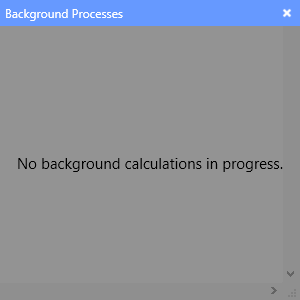
Once this icon is selected it will open a dialog that will display anything such as color schemes that are being processed while a user continues on with their work.  Or sit their idle taking up screen real estate.

2016 R2 Background Processes Dialog

Unfortunately I haven’t found a way to move this dialog from the lower right corner.

Foundation Walls – Wall Function

During a session of Revit Radio this month the question came up  “Why can I only model Foundation walls with the depth value?”  Of course I couldn’t answer this question with a simple answer, I went in-depth into the parameter “Function”.

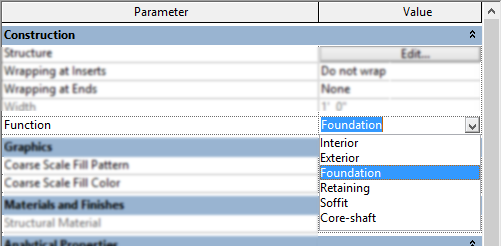
When the type properties of a wall is selected there is a property of “Function”, according to the help file this:

Categorizes the wall as Exterior, Interior, Retaining, Foundation, Soffit, or Core-shaft. Function is used in scheduling and to create filters that simplify a model for visibility or when exporting.

Wall Function

Yes these values can be used to generate filters to turn off wall of a given function, however what the help file fails to inform us is that these values also have other built in information associated to them.  The most obvious, or not so obvious due to the above question, is that if Foundation is selected as a property then this will disable the capability to model the wall with “Height” or “Depth” option and will be forced to “Depth”.  Hence only allow walls with this property to be modeled going down.  However the little known rule is that Revit will also remember settings that were used for the previous wall of the same function.  For instance if a wall who’s function is set to “Soffit” and it was modeled with a base offset of 8′ (2440mm) and then a wall who’s function is set to “Interior” will not be modeled with the same base offset but will use the previous “Interior” walls settings.  Usually when I am setting up templates for clients I pay close attention to these setting and keep things consistent within wall types.  The last template any wall with gypsum board on a single side was set to “Soffit”.

On a side note Doors, Floors, Stairs amongst other families also have the same “Function” parameter, however these only have the options for “Interior” and “Exterior” and really are there for generating filters.  I have submitted to Autodesk that more categories have these features such as Windows and Railings.  If the help file is true and I want to create a filter for “Interior” or “Exterior” then it would be nice to have it associated to all objects that could be in either location.